Off-Grid Power for Water Tank Monitoring Equipment

Wessex Water
Wessex Water supplies 280 million litres of treated water daily to over 1.3 million customers across the southwest of England, including many rural areas. In one remote Wiltshire location, the company needed a reliable, off-grid power solution to support continuous operation of water level monitoring equipment where no mains power was available.
The Challenge
The water tank in Wiltshire is equipped with monitoring systems that draw a continuous load of 1A at 24VDC. Previously, this site relied on two wind turbines and six solar panels to charge batteries and power the equipment. While this setup worked reasonably well during summer, winter months brought reduced solar and wind output, resulting in frequent battery depletion. To maintain operation, Wessex Water had to make multiple site visits to replace or recharge batteries — incurring approximately £3,000 in costs over one winter season alone. The company needed a solution that could provide reliable, autonomous power year-round while still integrating with existing renewable energy sources.
The Solution
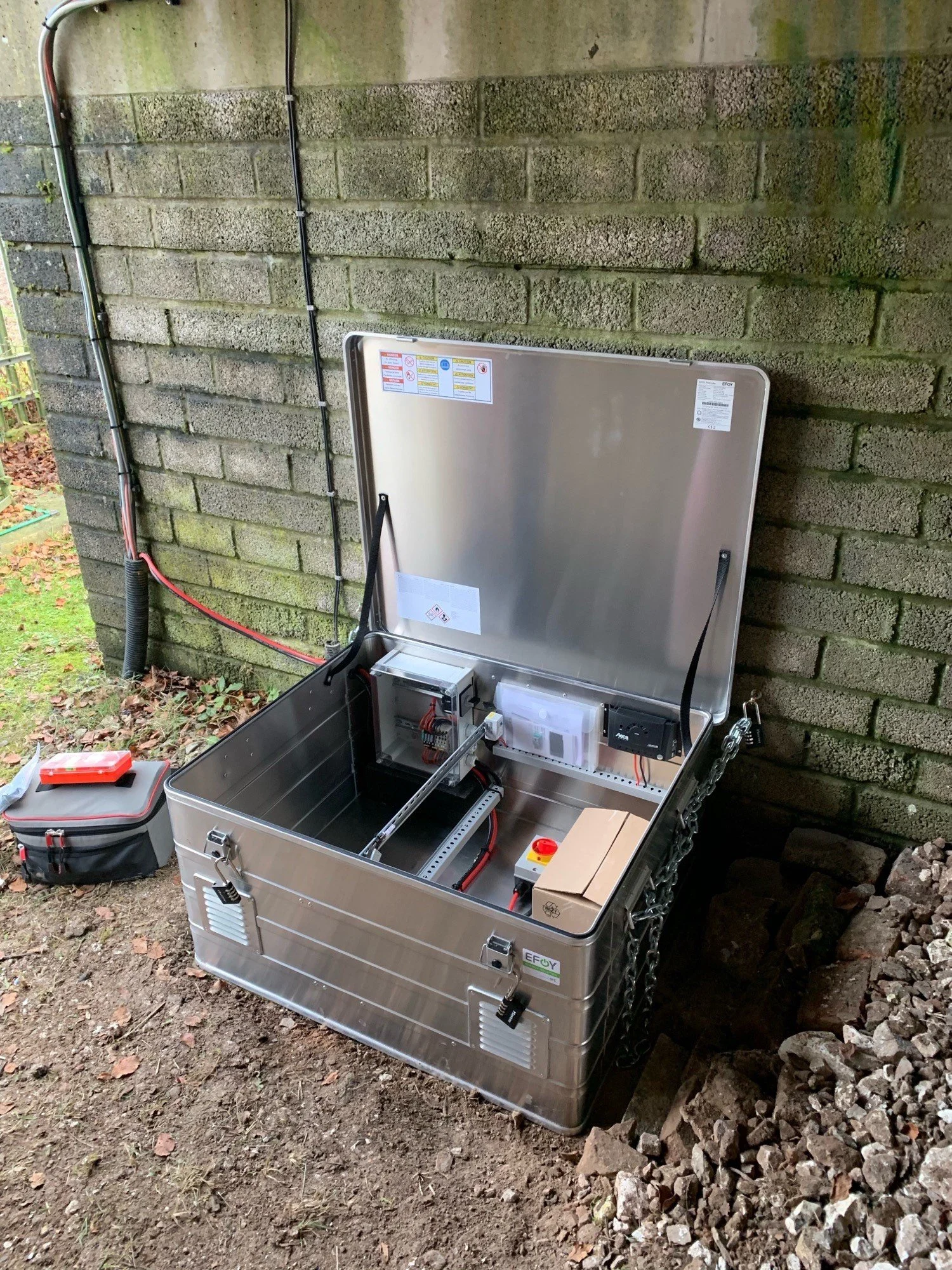
Wessex Water approached Fuel Cell Systems Ltd (FCSL) to explore the use of fuel cells for off-grid power support. After visiting the site, FCSL recommended deploying an EFOY Pro 2400 Duo fuel cell (equivalent to the EFOY Pro 2800) inside a ProCube 2060A enclosure. The enclosure includes 56 litres of methanol, allowing the system to run for several weeks without requiring a site visit. The fuel cell was connected in parallel with the battery bank and existing wind and solar inputs, ensuring seamless hybrid operation. Also a remote monitoring system was installed, allowing Wessex Water to remotely track battery voltage, fuel levels, and system alerts in real time.
Result
The integration of the EFOY Pro fuel cell into the existing renewable power setup has significantly improved the reliability of the water level monitoring system. Wessex Water now has a continuous, maintenance-free power source through winter months, greatly reducing site visit frequency and associated costs. The hybrid setup also ensures that wind and solar resources are still fully utilized when available, while the fuel cell provides consistent backup power. The addition of remote monitoring enhances operational confidence and allows for proactive maintenance, supporting uninterrupted service to rural communities.
“From installation in December 2019, up to mid-April 2020, no calls to site were needed. The fuel cell will not need to run much over the summer, but will be in automatic standby, ready to switch to charge mode when needed.”
Henry Mills, Sales Manager at Fuel Cell Systems
How it Works
The EFOY continuously monitors the battery voltage, automatically turning on and off to charge the batteries. A traditional style generator would run continuously. It effectively acts as a ‘battery charger’ ensuring that the batteries are kept within the optimal voltage range. Compared to an internal combustion generator, the EFOY fuel cell has so few moving parts that it has higher levels of reliability and reduced noise levels. The only emissions it produces are tiny amount of carbon dioxide and water.